

Quick Summary: Before writing a business plan or pitching investors, every Canadian entrepreneur needs to answer one critical question: is my business idea actually financially viable? A financial feasibility report gives you that answer – backed by data, not optimism.
Starting a business in Canada is exciting – but the numbers demand respect. 21.5 % of Canadian small businesses close before the end of their first year, and roughly half do not survive past five years, according to Statistics Canada data. One of the most preventable causes of early failure is skipping a structured financial feasibility analysis before launch.
This post walks you through exactly how to conduct a feasibility study for your business idea – covering startup costs, financial projections, break-even analysis, cash flow forecasting, profitability analysis, and business risk assessment. This framework will help you make a confident go-or-no-go decision, whether you are a first-time founder or a seasoned operator evaluating a new venture.
- 21.5 %: of Canadian small businesses fail in year one
- ~50 %: do not survive past five years in Canada
- 98.2 %: of all Canadian employer businesses are small businesses
- 5.8M: Canadians employed by small businesses – 46.6 % of the private workforce
What Is a Financial Feasibility Report?
A financial feasibility report is a structured analysis that determines whether a business idea can generate enough revenue to cover its costs and deliver a sustainable profit over time. Unlike a business plan – which assumes viability and maps out execution – a feasibility report asks the harder prior question: should this business even exist?
The financial component of a feasibility study examines:
✅ Total startup costs and capital requirements
✅ Projected revenue and expense forecasts (typically over 3–5 years)
✅ Break-even point – when income covers all costs
✅ Cash flow forecast – timing of money in and money out
✅ Profitability analysis – gross and net margins
✅ Return on investment (ROI) and payback period
✅ Sensitivity and risk analysis under different market scenarios
According to Innovation, Science and Economic Development Canada (ISED), between 2019 and 2023 an average of 104,500 businesses were created and 95,300 disappeared each year. That narrow margin highlights why rigorous pre-launch analysis is not optional – it is foundational.
Step-by-Step: How to Conduct a Feasibility Study
1. Estimate Your Startup Costs
Startup costs are one-time expenses incurred before the business generates its first dollar of revenue. Accurately mapping these costs is the foundation of your entire financial feasibility analysis. Underestimating them is one of the most common reasons Canadian startups run out of cash in their first year.
| Cost Category | Examples | Type | Priority |
|---|---|---|---|
| Legal & Registration | Business incorporation, trademarks, licences (federal/provincial) | One-time | High |
| Equipment & Technology | Machinery, computers, software, POS systems | One-time / recurring | High |
| Location & Leasehold | Deposits, renovations, signage, utilities setup | One-time | Medium–High |
| Inventory / Raw Materials | Opening stock, supplier minimums | One-time (replenished) | Medium |
| Marketing & Branding | Website, logo, initial advertising, social media setup | One-time + ongoing | Medium |
| Working Capital Reserve | 3–6 months of operating expenses as a cash buffer | Reserve | High |
| Professional Services | Accountant, lawyer, consultant fees | One-time + ongoing | Variable |
Tip for Canadian founders: Factor in HST/GST registration thresholds, provincial business licences, and whether you qualify for BDC or EDC financing programmes. These can significantly affect your initial capital requirements.
2. Build Your Financial Projections
Financial projections estimate your expected income and expenses over a defined future period – typically three to five years. For a feasibility study, you need at minimum a 12-month monthly projection. Use conservative assumptions based on:
Industry benchmarks from Statistics Canada or your trade association, competitor pricing research, and market demand data from your target geography. Build three scenarios: pessimistic, base-case, and optimistic. This is the core of your financial modeling.
Your financial projection should include:
✅ Revenue forecast: Units sold × average price, segmented by product/service line
✅ Cost of Goods Sold (COGS): Direct costs tied to delivering your product or service
✅ Operating expenses: Rent, payroll, marketing, insurance, utilities, software subscriptions
✅ Net income projection: Revenue minus COGS minus operating expenses
3. Calculate Your Break-Even Point
The break-even point is the sales volume at which total revenue equals total costs – meaning the business makes neither a profit nor a loss. This is one of the most critical outputs of a financial feasibility study because it tells you exactly how much you need to sell just to survive.
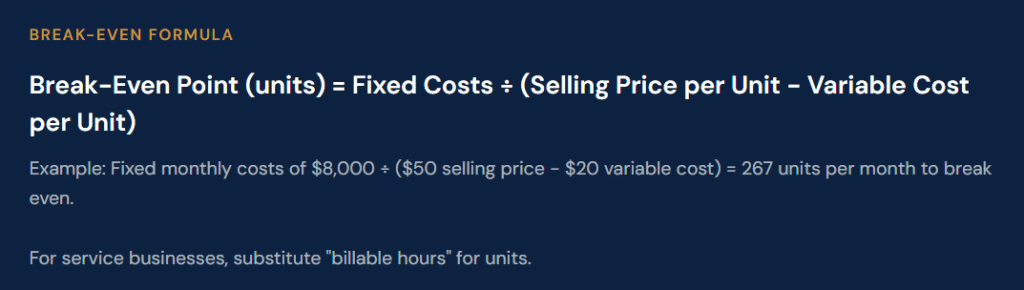
Once you know your break-even point, ask yourself: is this realistically achievable given your target market size and your sales capacity in the first 12–18 months? If not, your cost structure or pricing model needs revisiting before launch.
4. Forecast Your Cash Flow
A business can be profitable on paper and still fail – and in Canada, cash flow problems are the leading operational cause of small business closure. A cash flow forecast maps the timing of actual cash receipts and disbursements, month by month.
Key distinctions to model in your cash flow statement:
- Payment timing gaps (e.g., you invoice Net-30 but pay suppliers immediately)
- Seasonal revenue fluctuations – critical for retail, construction, and tourism sectors
- Loan repayment schedules and interest payments
- GST/HST remittance dates (quarterly or monthly depending on your registration)
5. Conduct a Profitability Analysis
Profitability analysis answers whether your business will generate meaningful returns relative to the risk and capital invested. Key metrics to calculate:
| Metric | Formula | What It Tells You | Healthy Benchmark |
|---|---|---|---|
| Gross Profit Margin | (Revenue − COGS) ÷ Revenue × 100 | Efficiency of core operations | Varies by industry; retail ~30–50 % |
| Net Profit Margin | Net Income ÷ Revenue × 100 | Overall bottom-line profitability | 5–20 % for SMEs |
| Return on Investment (ROI) | (Net Profit ÷ Total Investment) × 100 | Value generated per dollar invested | > cost of capital |
| Payback Period | Initial Investment ÷ Annual Net Cash Flow | Years to recover startup investment | <3–5 years for most SMEs |
6. Run a Business Risk Assessment
No feasibility study template is complete without a business risk assessment – specifically a sensitivity analysis. This tests how your financial outcomes change when key assumptions shift: What if revenue is 20 % lower than projected? What if a key supplier raises prices by 15 %? What if the Bank of Canada changes interest rates?
For Canadian businesses, additional risk factors to model include: exchange rate exposure if sourcing from the U.S., provincial regulatory changes, seasonal demand cycles, and sector-specific risks outlined by BDC’s industry benchmarking data.
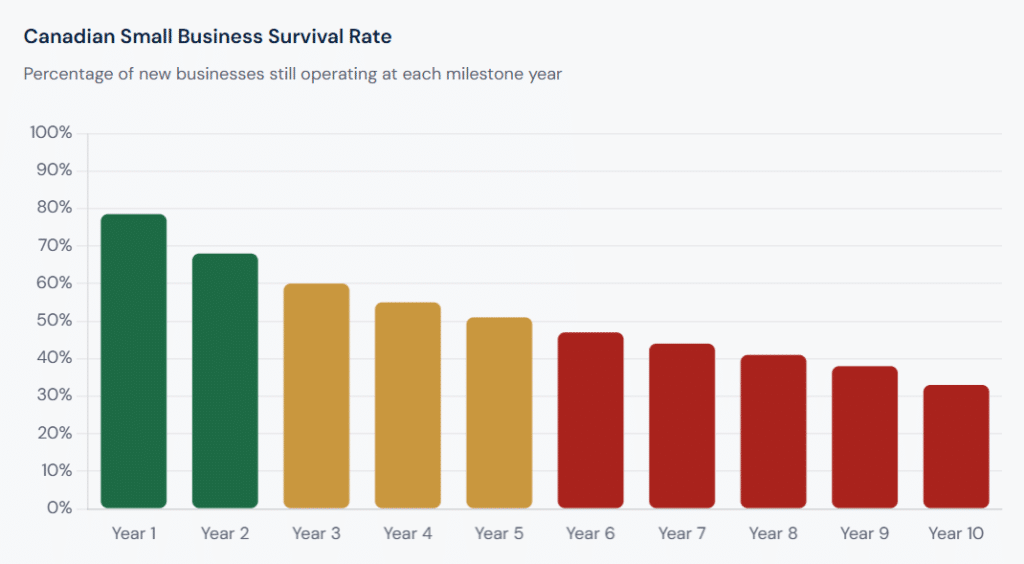
Canadian Business Survival Rates by Year
The chart below illustrates the cumulative survival rate of new Canadian small businesses from Year 1 through Year 10, based on data from Statistics Canada and ISED. Each year represents the percentage of businesses originally launched that are still operating.
What to Include in a Financial Feasibility Study Template?
A structured feasibility study template for Canadian startups should be organized as a concise document (typically 10–20 pages) covering the following sections:
| # | Section | Key Content |
|---|---|---|
| 1 | Executive Summary | Business concept, go/no-go recommendation, key financial highlights |
| 2 | Business Concept Overview | Product/service description, target market, value proposition |
| 3 | Market Analysis | Market size (TAM/SAM/SOM), competitive landscape, demand validation |
| 4 | Startup Cost Schedule | Itemized one-time costs, working capital needs, funding sources |
| 5 | Revenue & Expense Projections | Monthly P&L for Year 1, annual summary for Years 2–5 |
| 6 | Break-Even Analysis | Break-even units/revenue, timeline to break-even |
| 7 | Cash Flow Forecast | 12-month monthly cash flow statement |
| 8 | Profitability Metrics | Gross margin, net margin, ROI, payback period, IRR |
| 9 | Risk & Sensitivity Analysis | Best/base/worst case scenarios, key risk factors and mitigations |
| 10 | Conclusion & Recommendation | Go / Conditional Go / No-Go decision with rationale |
Common Mistakes That Derail Financial Feasibility Studies
Overstating revenue in Year 1. Most new businesses take 12–18 months to build meaningful sales momentum. Apply a conservative ramp-up factor – typically 30–50 % of your theoretical capacity – to your first year projections.
Forgetting working capital. Many founders calculate startup costs but ignore the need for 3–6 months of operating reserves to cover expenses before the business reaches positive cash flow. This gap is a leading cause of business failure within the first year in Canada.
Using a single-scenario model. Building only a base-case projection leaves you blind to downside risk. Always build a pessimistic scenario using 70 % of projected revenue and 110 % of projected costs. If the business cannot survive that scenario, your risk profile is too high.
Ignoring Canadian-specific costs. Payroll taxes (CPP, EI), WSIB premiums, provincial sales tax obligations, and Canadian corporate tax rates must all be factored into your model from day one.
Need a Financial Feasibility Report for Your Business?
Saz Square Business Consultants specialize in financial feasibility analysis, startup financial modeling, and business risk assessment for Canadian entrepreneurs and SMEs. Our analysts build solid, investor-ready feasibility reports so you can launch with confidence – see our real-world client results to understand what that looks like in practice.
The Bottom Line
A thorough financial feasibility analysis is the difference between building a business on evidence and building one on hope. By rigorously estimating startup costs, building conservative financial projections, calculating your break-even point, forecasting cash flow, and stress-testing your assumptions through business risk assessment, you give yourself the clearest possible picture of your venture’s potential – before committing significant capital.
In a country where 98.2 % of businesses are small businesses, the entrepreneurs who conduct thorough feasibility analysis for startups before launch consistently outperform those who don’t. The work you do now translates directly into better funding conversations, smarter operational decisions, and a far higher probability of long-term survival.
If you need guidance structuring your financial feasibility report or building a financial model customized to the Canadian market, Saz Square team is here to help.
Sources & References:
- Innovation, Science and Economic Development Canada. Key Small Business Statistics 2025.
- Statistics Canada. Failure Rates for New Canadian Firms: New Perspectives on Entry and Exit. Catalogue no. 61-526-XIE.
FAQs
What is a financial feasibility report?
A financial feasibility report evaluates whether a business idea can generate enough revenue to cover costs and sustain long-term profitability before launch.
How do you prepare a financial feasibility report?
Estimate startup costs, build revenue and expense projections, calculate your break-even point, forecast cash flow, and stress-test assumptions through scenario-based risk analysis.
What is a financial feasibility analysis?
A financial feasibility analysis is a structured assessment of a business idea’s economic viability – examining costs, projected income, cash flow, and return on investment.
What are the four elements of a financial feasibility analysis?
The four core elements are: startup cost estimation, financial projections, break-even analysis, and cash flow forecasting – together determining whether the venture is financially viable.
Can ChatGPT do financial analysis?
ChatGPT can outline frameworks and draft projections, but it cannot access real market data, validate Canadian-specific tax obligations, or replace a qualified financial consultant’s judgment.