

If you are ready to raise seed capital in Canada, begin with three concrete steps:
- Join a provincial angel network (for example, Angel One or Maple Leaf Angels) and attend its next pitch night.
- Polish a 10-slide deck and financial model, then ask a warm referrer—mentor, lawyer, or accelerator manager—to introduce you to two targeted investors.
- Follow up within 24 hours, provide diligence docs in one share-drive folder, and negotiate a founder-friendly SAFE.
Founders who complete this sequence secure their first cheque three times faster than those who “spray and pray.” Stick with it, track every lead and iterate.
Why angel investors matter for Canadian startups
Angel investors supply the first outside equity when revenue is small but growth potential is large. According to the National Angel Capital Organization (NACO), angels poured CA $262 million into early-stage companies in the most recent reported year, even after a 31 percent pull-back in 2023 (State of Angel Investment in Canada | LinkedIn). They invest earlier than venture capital funds, often between CA $25k and CA $250k per cheque, and usually bring mentorship and contacts.
Crowdfunding spreads risk across many tiny cheques; angels, by contrast, concentrate expertise and move quickly.
1. Understanding angel investing in Canada
Definition and role
An angel investor is an accredited individual who invests personal capital in exchange for equity or a convertible instrument such as a SAFE. They help founders refine strategy, open doors to customers, and bridge the gap to a Series A round.

National and provincial networks
Canada’s ecosystem for Angel Investors rests on a layered structure of national, provincial, and local groups. Tracxn’s May 2025 tally lists 63 active angel networks that have channelled CA $21.2 billion into 2,651 funding rounds—proof that organised angels power most early-stage deals in the country. (Top Angel Network in Canada – May, 2025) | Tracxn)
At the national level, the National Angel Capital Organization (NACO) acts as policy advocate, data clearing-house, and convener of the annual summit where term-sheet templates and best-practice guides are released. Ontario founders then plug into Angel Investors Ontario (AIO), an umbrella for eleven city-based clubs that collectively review more than 400 pitches a year. Beneath these lie robust regional hubs: Golden Triangle Angel Network in Waterloo (deep-tech, SaaS), Valhalla Private Capital across the Prairies (resource tech, ag-tech), and Island Capital Partners in Atlantic Canada (ocean and health innovation). This three-tiered fabric lets a startup begin local, win an early cheque, and then syndicate nationally without leaving home turf.
Market size
Deal flow has climbed steadily since the 2010 rebound. Total disclosed angel deployment stands at CA $1.66 billion, according to NACO’s latest investment activity report (Drop in Angel Funding | NACO.)
Four provinces dominate: Ontario captures fintech and enterprise SaaS; British Columbia leads in cleantech; Alberta excels in ag-tech; and Québec specialises in AI and life-sciences. Together they recorded roughly three-quarters of all angel cheques last year. Atlantic Canada, while smaller, posted the highest growth rate after aggressive tax-credit reforms. For founders, this distribution means concentrating outreach on the “big four” provinces first, then leveraging regional credits to stretch every dollar of seed capital.
2. Is your startup “angel-ready”?
Investors will write cheques only when three boxes are ticked:
| Requirement | What founders must show | Fast-track tip |
| Market validation | Paying pilots, LOIs, or at least 1,000 wait-list sign-ups | Run a two-week paid ad test and publish the metrics |
| Scalable model | Gross margin > 50 %, clear unit economics | Share a 12-month cohort retention chart |
| Professional docs | Deck, forecast, cap-table, data-room index | Use SAZ Square’s expert financial and business advisory services |
Remember to keep the file names clean, version-controlled, and share-only-as-view.
3. Where to find angel investors in Canada
Angel networks and groups
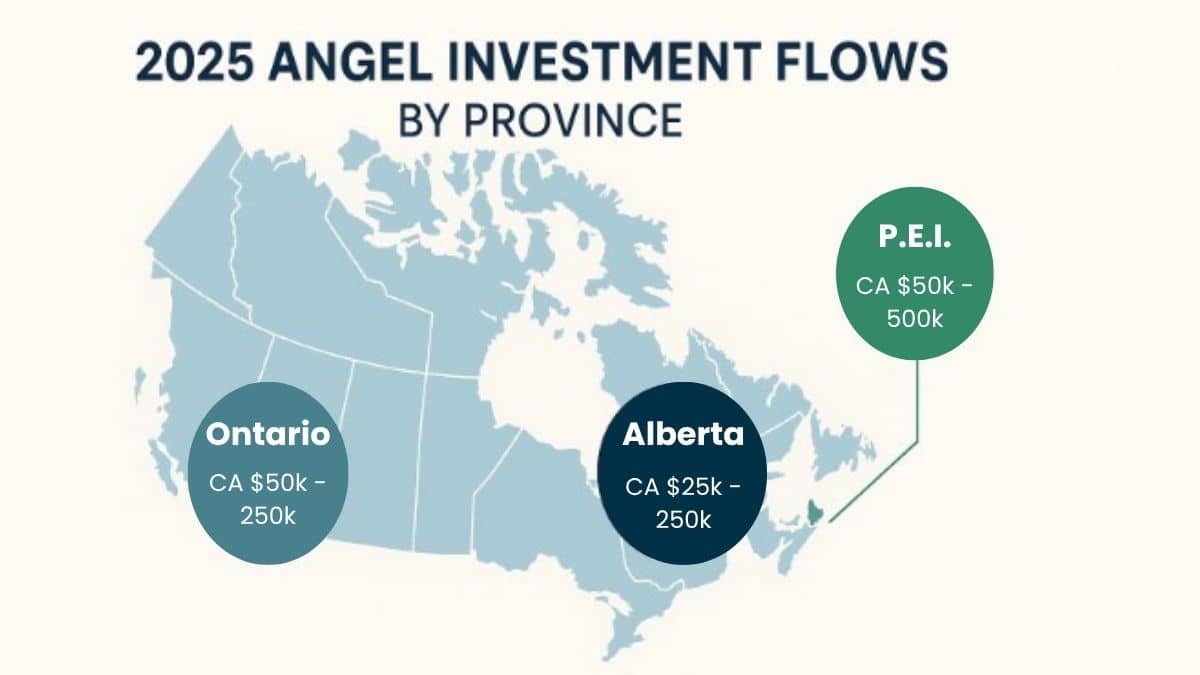
Below is a quick reference table (save for your CRM):
| Network | Province | Typical cheque | Website |
| Angel One | Ontario | CA $100k–250k | angelonenetwork.ca |
| Maple Leaf Angels | Ontario | CA $50k–150k | mapleleafangels.com |
| Valhalla Private Capital | Alberta | CA $25k–200k | valhallaprivatecap.com |
| Golden Triangle Angel Network | Ontario | CA $75k–250k | goldentriangleangelnet.ca |
| Island Capital Partners | PEI | CA $50k–500k | islandcapital.vc |
Incubators and accelerators
Programs such as Creative Destruction Lab, DMZ, Communitech, CDL-Atlantic, Volta host demo-days where members of NACO attend and write follow-on cheques on the spot.
Online platforms
- AngelList Canada – filter by location and ticket size.
- FUNDICA Match – AI search for Canadian angels.
- EquityNet, FrontFundr – hybrid equity-crowdfunding with accredited participation.
Events and competitions
Pitch at StartupFest (Montréal), CIX Summit (Toronto), The Firehood (women-led deals), and regional angel summits. Winning prizes is secondary; the real goal is scheduling one-on-one meetings the morning after.
Social and professional networking
Use LinkedIn Sales Navigator to create a list of investors who follow similar portfolios. Engage with their posts for two weeks before sending a note. Avoid mass InMail blasts.
4. Crafting the perfect outreach
Write concise, personalized messages that cite a mutual connection or portfolio overlap. A proven cold-email framework:
Subject: Winnipeg SaaS solving food waste—intro?
Hi {First Name},
I noticed you backed Flashfood and often invest in sustainability software. We cut grocery shrink by 15 percent for Loblaws, live in 24 stores, MRR $28 k. Deck attached; would love your feedback next week.
— {Your Name}
Open rates average 57 percent when the subject references city + category.
5. From first meeting to term sheet
A typical Canadian angel process runs four to six weeks:
- Intro call – 30 minutes.
- Data-room review – 7 days.
- Partner Q&A – 60 minutes.
- Syndicate vote.
- Term sheet issued – SAFE at CA $4–8 million pre-money or 20 percent discount on next round.
Expect a 10× return target over five to seven years (Pros and Cons of Using Angel Investors | Startup Grind).
Provide:
- Historical P&L, forecast, and key assumptions.
- Proof of IP ownership.
- Customer references.
Keep a running diligence log so you answer gaps within 24 hours.
6. Negotiation tips and red flags
Seasoned founders approach negotiations with clear guard-rails.
First, press for a valuation cap that mirrors recent West-Coast precedents for your sector; Canadian caps often trail U.S. peers, but data-driven comparables close that gap. Second, secure language that permits future raises under CA $5 million without investor veto—critical for bridging to Series A. Third, offer the lead angel a board-observer seat rather than full directorship; you gain guidance without ceding governance.
Conversely, treat certain terms as deal-breakers. Walk away if an investor requests salary claw-backs, embeds full-ratchet anti-dilution rights that linger past Series A, or tries to steer product decisions outside their expertise. A clean cap-table today preserves leverage tomorrow.
7. Legal, tax, and regulatory corner
- Accredited investor rule – Income ≥ CA $200k (single) or assets ≥ CA $5 million. Angels must self-certify under NI 45-106.
- Tax credits – BC Eligible Business Corporation (30 %), Québec R&D (45 %), Saskatchewan Technology Start-up Incentive (45 %).
- LSVCCs – Labour-Sponsored Venture Capital Corporations deploy pooled retail money; good for later seed rounds but slower process.
- Exemptions – Crowd-funding exemption (< CA $1.5 million) and offering memorandum exemption; stay within limits when syndicating.
Consult securities counsel before broadcasting your raise.
8. Alternatives and complements
| Source | Speed | Typical ticket | Best for |
| Angels | 1–3 months | CA $25k–250k | Pre-seed / mentorship |
| Equity crowdfunding | 2–4 months | CA $250–2 000 per investor | Consumer-facing products |
| LSVCC | 4–6 months | CA $250k–2 million | Growth-stage in eligible provinces |
| Seed VC fund | 3–5 months | CA $500k–2 million | Rapid scale, SaaS |
| Government grant | 3–12 months | CA $50k–500k non-dilutive | Deep-tech R&D |
Use a mix. Many founders raise an initial CA $150k angel SAFE, close grants such as IRAP, then court a VC.
9. Success story | SkipTheDishes
This Winnipeg food-delivery app bootstrapped in 2012, landed seed cheques from Prairie angels, and ultimately raised CA $25 million across six rounds before its exit to Just Eat (SkipTheDishes’ Funding Rounds | Tracxn). Local investor guidance on logistics pricing, not just cash, helped the founders outpace U.S. rivals.
10. Common mistakes to avoid
Many promising raises collapse because founders mismanage early steps.
Chasing every angel list without researching fit: Chasing every online list of Angel Investors without first confirming sector fit wastes precious weeks and signals desperation.
Sending 40-slide decks: Sending bloated 40-slide decks buries your value proposition; ten crisp slides outperform.
Ignoring tax-credit paperwork until December: Tax-credit forms left until December can forfeit up to 45 percent in refundable credits, shrinking runway.
Accepting valuation caps far below U.S. peers: Accepting valuation caps far below comparable U.S. rounds locks in punitive dilution that haunts later stages.
Waiting for the “perfect” traction number—momentum raises money: Waiting for a “perfect” traction milestone often delays the raise until competitors leap ahead—momentum, not perfection, convinces investors to fund growth.
Keep these pitfalls in view and your path to angel financing stays clear.
Conclusion
Canadian founders no longer need to guess where capital hides. Map the angel networks above, target the investors whose past deals mirror your sector, and arrive with a crisp deck plus data-room link. When you control the process, you shorten the raise and keep more equity.
SAZ SQUARE Business Consultants can audit your materials, sharpen your story, and coach you through the term-sheet maze. Book a free 30-minute strategy call and start closing your funding gap today.
Next steps for you
- Tools: AngelList, Fundica, NACO portal, LinkedIn Sales Navigator.
- Events: StartupFest (July), NACO Summit (September), CIX (October).
Personalize outreach to the province you want to plant HQ in; many angels invest local.
FAQs
How much do Canadian angels usually invest?
Between CA $25k and CA $250k per investor, with groups pooling up to CA $1 million per round.
Do I need a formal business plan?
A Lean six-page plan plus a robust forecast is enough. Angels care more about traction and team.
Additionally, you can check out our step-by-step business plan guide here.
Which provinces offer the richest angel tax credits?
British Columbia (30 %), Saskatchewan (45 %), Québec (45 % on R&D) top the list.
Can foreign founders raise from Canadian angels?
Yes, if the corporation is registered in Canada or the investor uses the offering-memorandum exemption.
How long does due diligence take?
Four to six weeks on average—longer if IP or regulatory risk is involved.
How much do you pay an angel investor?
You do not “pay” them; they buy equity or a SAFE. Typical angels receive 10–25 percent ownership for seed-stage cheques.
Where is the best place to find an angel investor?
Provincial angel groups and accelerator demo-days concentrate accredited investors who actively write cheques and prefer local deals.
How hard is it to find an angel investor?
It is challenging but doable; targeted outreach with traction metrics secures meetings within weeks for most Canadian founders who persist.