

Starting a business in Canada is exciting – but without a roadmap, it’s a gamble. Research consistently shows that founders with a formal plan are 260 % more likely to actually launch their businesses and twice as likely to grow them successfully.
Yet, 41 % of startups still fail due to inadequate planning.
If you’re a first-time founder in Toronto or an aspiring entrepreneur in Vancouver, our startup planning guide walks you through everything you need to build a business plan for startups that attracts investors, secures funding, and sets your venture on the path to sustainable business growth.
Why Every Canadian Startup Needs a Business Plan in 2026
A business plan isn’t just paperwork – it’s your startup’s strategic backbone. A business plan is a detailed document that explains your business idea, target market, competitive advantages, and financial goals, serving as a roadmap for your startup and helping secure funding from investors or lenders.
Here’s the reality for Canadian founders:
| Statistic | Data Point |
|---|---|
| Canadian startup failure rate | Approaching 90 % |
| First-time founder success rate | 18 % |
| Startups failing from lack of demand | ~33 % |
| Startups with plans more likely to get funding | 2.5× more likely |
| Federal Budget 2025 early-stage VC commitment | $750 million CAD |
In Canada, having a comprehensive business plan is important for obtaining financing from banks and investors, as well as meeting regulatory requirements. With only 21 VC funds closed in 2025, raising just $2.1 billion – one of the worst fundraising years since 2018 – a standout business plan is more critical than ever for Canadian startups competing for limited capital.
👉 If you’re still early in the process, review our guide on how to start a business in Canada alongside your planning, so you don’t miss key setup steps.
Traditional vs. Lean Business Plan: Which Is Right for You?
Before you start writing, choose the format that fits your stage and goals. There are two main types of business plans: traditional and lean. A traditional business plan is longer and written in paragraphs, while a lean business plan is shorter and often features bulleted lists.
👉 Your plan format also depends on your path. First decide whether to start or buy a business, then choose a traditional or lean plan that fits.
| Feature | Traditional Plan | Lean Startup Plan |
|---|---|---|
| Length | 15-25 pages | One page |
| Time to Complete | 3-6 weeks | As little as one hour |
| Best For | Investors, bank loans, partners | Idea validation, early-stage testing |
| Detail Level | Comprehensive | Key elements only |
💡 Pro Tip: Many successful entrepreneurs start with a lean plan to validate their concept, then develop a full traditional plan when pursuing funding. This two-stage approach saves time and increases your chances of success.
Business Plan Structure: 10 Essential Sections
A solid business plan includes: Executive Summary, Company Description, Market Analysis, Organization & Management, Products/Services, Marketing Plan, Funding Request, Financial Projections, Appendix, and Cover Page.
Let’s break down each section with business planning tips personalized for Canadian founders:
1. Executive Summary
The executive summary is a concise, powerful snapshot of your entire plan. It should grab the reader’s attention and make them want to learn more. It typically includes your mission statement, a brief description of your product or service, and basic financial highlights.
Your executive summary should be 1-2 pages long and summarize key points from each section of your business plan. Although the executive summary comes first, this section is written after you have completed the other sections.
Include:
- Business name, location, and mission
- The market problem you solve
- Revenue highlights or projections
- Funding request (if applicable)
2. Company Description & Value Proposition
Clearly describe what your business does and, more importantly, the problems it solves for customers. Outline your company’s long-term vision and core values. For Canadian startups, consider mentioning your province of incorporation, federal or provincial registration, and alignment with Canada’s economic priorities (e.g., clean tech, AI, agriculture).
3. Market Research & Analysis
This is where your business strategy proves you understand the Canadian landscape. Estimate market size. Perform an analysis of your total addressable market to approximate the size of your target market; this clarifies how big of an opportunity there is for your startup business.
Key actions:
- Define your Total Addressable Market (TAM), Serviceable Available Market (SAM), and Serviceable Obtainable Market (SOM)
- Check out Statistics Canada’s Small Business Hub – it offers resources to help existing and aspiring entrepreneurs plan and manage their enterprises.
- Identify market trends unique to Canada (e.g., Canada’s commitment to net-zero emissions by 2050 fuels explosive growth in energy efficiency sectors)
4. Competitive Analysis
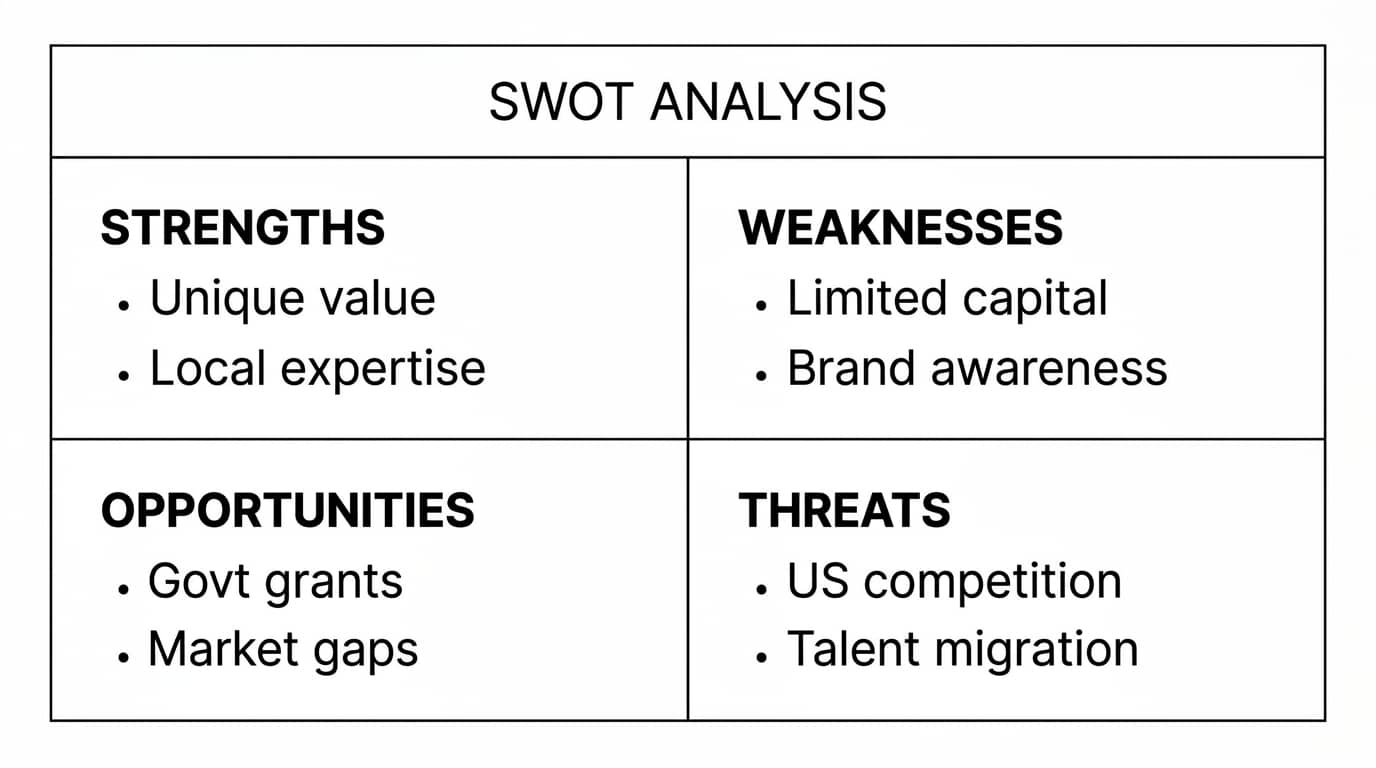
Analyze your competitors’ products, pricing, marketing strategies, and market share. List your business’s strengths, weaknesses, opportunities, and threats (SWOT).
Competitive Analysis Framework:
5. Products or Services
Describe exactly what you’re selling, the pricing model, and your unique selling proposition (USP). Explain how it addresses a genuine pain point. A profitable business idea matches real customer demand with a model that can grow efficiently. Market demand reveals itself through long waiting lists for services, customers willing to pay premium prices, or search data showing people actively looking for solutions.
6. Marketing & Sales Strategy
No one will buy your products if they don’t know about them. That’s why it’s vital to think about your marketing strategy, even at this early stage. This section functions as a marketing roadmap. Keep your target market top of mind as you develop it.
Cover the 4 Ps: Product, Price, Place, and Promotion – these form the foundation of your marketing strategy section and help define how you’ll reach customers.
7. Operations Plan
Detail your location, equipment and machinery, production planning, customer interactions, and research and development. Include how automation, dropshipping, or AI-driven tools improve operations. Your operations section should show how your business can adapt to challenges like supply chain issues, shifting tariffs, or geopolitical changes.
8. Management Team
Your management team section showcases the people driving your business forward. It’s your chance to highlight their credibility and relevance. Start by highlighting your founders and key executives, focusing on specific experience and skills that directly relate to your business.
A significant 82 % of successful business owners possess the right qualifications and relevant experience to manage a company effectively.
9. Financial Projections & Goals
This is the section investors scrutinize most. Include:
- Revenue projections (3-5 years)
- Break-even analysis
- Cash flow forecast – When preparing a business plan, you will need to include a cashflow forecast.
- Startup costs and operating expenses
- Profit & loss statement
| Financial Document | Purpose |
|---|---|
| Income Statement (P&L) | Shows projected revenue vs. expenses |
| Cash Flow Statement | Tracks money in/out monthly |
| Balance Sheet | Snapshot of assets, liabilities, equity |
| Break-Even Analysis | When revenue covers all costs |
10. Funding Request & Appendix
If you’re seeking investment, be specific: state how much you need, how it will be used, and the expected return. For startups, a business plan is essential when trying to raise capital. Investors want to know your business model, how you plan to grow, and what kind of return they might expect. A clear plan shows you’ve done your homework.
Canadian Funding Programs to Reference in Your Business Plan
A winning startup business plan template for Canada should demonstrate awareness of available government support.
Here are the top programs for 2026:
| Program | Type |
|---|---|
| IRAP (NRC) | Non-repayable grant – up to $500,000 per project, covering up to 80% of salary costs for technology R&D |
| SR&ED Tax Credit | Tax credit – $4.5 billion distributed annually; Budget 2025 doubled the expenditure limit to $6 million |
| CSBFP | Government-backed loan – up to $1.15M at prime + 3% |
| Futurpreneur | Loan + mentorship – raised to $75,000 (up from $60K), for ages 18-39 |
| CanExport SMEs | Up to $50,000 for international business development |
Most programs can be stacked – the total government assistance cap is 75 % of project costs.
5 Business Planning Tips to Make Your Plan Stand Out
- Use AI Tools Wisely – A generative AI tool like ChatGPT or CoPilot can be useful in supplementing your research, as long as you review the output with a critical eye and avoid entering any personal information.
- Treat It as a Living Document – Review and update your business plan at least quarterly, or whenever significant changes occur. For startups and rapidly growing businesses, monthly reviews might be more appropriate.
- Think Strategically, Tactically, and Operationally – Strategic thinking defines your larger overarching plans. An example of a broad marketing strategy is paid media. Tactical thinking defines the individual actions within your strategy, such as split-testing your copy and creatives.
- Get Expert Feedback – Whether this is a mentor or another entrepreneur, external feedback can be critical to a solid business plan. If you are between 18 and 39, Futurpreneur Canada can also assist you in finding a mentor.
- Validate Before You Scale – Try validating your business idea with a few customers. This is the best way to minimize risk when starting a business.
Common Mistakes Canadian Startups Should Avoid
- Ignoring competitive analysis in the Canadian market
- Overestimating financial projections – Detailed financial projections are usually wrong, sometimes laughably so. A five-year forecast for a startup is basically a fantasy. Keep yours grounded with clear assumptions.
- Neglecting the Canadian funding landscape – Not referencing available grants and programs signals a lack of preparation
- Writing it once and filing it away – Your business plan should be a living document that you revisit and update periodically.
- Skipping market research – One-third of failures stem from no product demand (34 %).
Final Thoughts
A business plan will help you to start and grow your business. It shows you where your business might have problems or do well. A plan lets you make smart choices before you commit your time or money.
The Canadian startup ecosystem faces real challenges in 2026 – seed rounds in Canada’s top tech cities are about 40 % smaller than in comparable U.S. hubs, and Canada is losing entrepreneurial talent and ambition to southern neighbours. But with $750 million in federal commitments toward early-stage VC funding and robust grant programs like IRAP and SR&ED, founders who plan strategically have every reason to build here.
Your business plan is the competitive edge that separates the 10 % who succeed from the 90 % who don’t.
Start writing yours today.
FAQs
How to write a business plan for a startup?
Start with your executive summary, then outline your company description, market research, competitive analysis, products/services, marketing strategy, operations plan, management team, and financial projections. Use a unique prompt for each section instead of tackling the whole plan at once – the same applies to writing it yourself. Build it section by section, validate your assumptions with real data, and keep it under 25 pages.
What is the 50-100-500 rule for startups?
The 50-100-500 rule is a well-known growth framework. Your company is no longer a startup if you have a $50 million revenue run rate, 100 or more employees, or are worth over $500 million. Alex Wilhelm of TechCrunch created this rule to draw a clear line between early-stage ventures and mature companies. For Canadian founders, it’s a useful benchmark to track how far you’ve come.
Is $5,000 enough to start a business?
Yes – but with limits. Any business can be registered with the government and the name licensed for under $5,000. The real question is whether your business can run for just $5,000, and for many the answer will be no. $5,000 can launch a low-overhead business like tutoring, lawn care, cleaning services, or online freelancing. Focus on service businesses that don’t require inventory or expensive equipment. Build a detailed budget in your business plan first, then explore Canadian grants and loans to supplement your capital.
What are the 7 stages of a startup?
A venture capital-backed startup goes through seven stages: ideation, MVP, investment, product-market fit, go-to-market, growth, and maturity. Each stage has one objective and demands one focus from you, the founder. Not every startup follows them in a straight line – but knowing which stage you’re in helps you prioritize what matters most right now.
Can ChatGPT write a full business plan?
It can help obviously – but it can’t do it all on its own. ChatGPT is a generative AI tool that is known to help users in simplifying complex tasks, but it can also sometimes act as a *word generator*. So it can be a co-pilot for drafting, organizing, and refining a business plan. However, ChatGPT might not conduct market research that effectively for you, or retrieve accurate, up-to-the-minute data from external sources. Also, all numbers and assumptions must be validated externally. You can use it to beat writer’s block and structure your thinking – then layer in your own financials, Canadian market data, and competitive insights to make it investor-ready.