

Starting a business in Canada without a roadmap is like navigating the Trans-Canada Highway with no GPS and no map. You might get somewhere, but you will exhaust your resources, miss critical turns, and run out of fuel long before you reach your destination.
The numbers reflect that reality. Canada ranks #5 globally in startup ecosystem strength, with over $8.2 billion in venture capital deployed in 2024. Yet despite that momentum, nearly 90 % of Canadian startups still fail.
The root cause is almost never the idea. It is the absence of a structured plan.
A clear roadmap gives Canadian startups the structure, milestones, and execution plan to outperform a 90 % industry failure rate.
Business roadmap development for startups is not a box you tick before your first investor pitch. It is the operational foundation that transforms a concept into a fundable, executable, and scalable business.
This post breaks down exactly what a startup roadmap does, why it matters, and when to bring in expert business planning services to build one correctly.
What Is Business Roadmap Development for Startups?
Business roadmap development for startups is the structured process of defining where a company is going, what milestones it must achieve, what steps are required to get there, and how progress will be measured, all within a realistic, time-bound framework.
Unlike a traditional business plan, which can become outdated almost as soon as it is written, a startup roadmap is a living document. It provides enough structure to align your team and stakeholders while remaining flexible enough to adapt as you gather real market signals.
At its core, a startup roadmap answers four foundational questions every founder must resolve:
- Where is the business right now?
- Where does it need to be, and by when?
- What resources are required to close that gap?
- How will progress be tracked and measured?
For Canadian founders navigating funding rounds, regulatory timelines, and competitive market conditions, this level of clarity is not optional. It is survival infrastructure.
Why Do Most Canadian Startups Fail Without a Roadmap?
Most Canadian startups fail because they operate without a defined business strategy for startups: no validated market fit, no milestone accountability, and no structured execution plan to guide critical decisions.
Only 10 % of startups succeed globally, and Canada’s failure rates are no exception. Breaking down why reveals a familiar pattern:
- 42 % of startups collapse due to misreading market demand
- 29 % run out of funding before achieving sustainable revenue
- 23 % suffer internal team breakdowns
- 19 % get outpaced by better-prepared competitors
None of these failure modes are random. Each one is a direct consequence of decisions made without a structured plan. A startup that misreads market demand has skipped validation milestones. One that runs out of funding has failed to map cash flow against a realistic growth timeline. One overtaken by competitors likely never built competitive positioning into its founder plan.
It gets sharper at the funding level: approximately 5 to 10 % of pre-seed funded startups survive to the Series A stage, even after securing investor capital. Money without a roadmap is still a fast track to closure. In a Canadian market where Series A median valuations have climbed to $22 million in 2025, founders without a roadmap face increasingly steep odds.
Founders who combine a structured roadmap with a focused business plan to attract investors enter funding conversations with a measurable edge over those who rely on pitch decks alone.
What Does a Startup Roadmap Include? Core Components and Stages
A complete startup roadmap covers six core components: market validation, startup structure, product or service development, funding strategy, launch steps, and post-launch growth milestones.
The table below maps each stage to its primary activities and measurable output:
| Roadmap Stage | Key Activities | Measurable Output |
|---|---|---|
| Discovery and Validation | Market research, competitor analysis, customer profiling | Validated business concept |
| Startup Structure | Legal registration, team roles, operational workflows | Company foundation in place |
| Product or Service Development | MVP definition, development sprints, testing, iteration | Launch-ready offering |
| Funding Strategy | Investor targeting, pitch deck, grant identification | Capital secured or runway defined |
| Launch Steps | Go-to-market plan, sales activation, marketing calendar | Successful market entry |
| Growth and Scaling | KPI tracking, expansion planning, new market entry | Scalable and repeatable model |
Each stage builds directly on the previous one. Founders who skip the discovery and validation phase and jump straight to product development account for a disproportionate share of the 42 % who fail because nobody wanted what they built.
How Does a Roadmap Define and Protect the Founder Plan?
A founder plan is the personal strategic layer embedded within the business roadmap. It defines the founder’s roles, decision-making authority, resource commitments, and individual accountability across each milestone.
Many early-stage founders treat the roadmap as an investor-facing document and keep the founder plan informal. That separation is costly. A roadmap without a founder plan is a strategy without an owner.
A strong founder plan answers the questions that no investor deck addresses:
- Who owns each key decision when the team disagrees?
- What does the founder personally commit to in the first 90 days?
- How are priorities ranked when resources run out?
- What personal capital, time, and expertise are on the line?
Research analyzing startup failure patterns consistently shows that every major failure driver is a strategy deficit: misaligned founders, poor go-to-market execution, inadequate competitive positioning, and broken business model design. Not one is a technology or product failure. The founder plan closes that gap by tying business strategy for startups to real human accountability rather than projected slides.
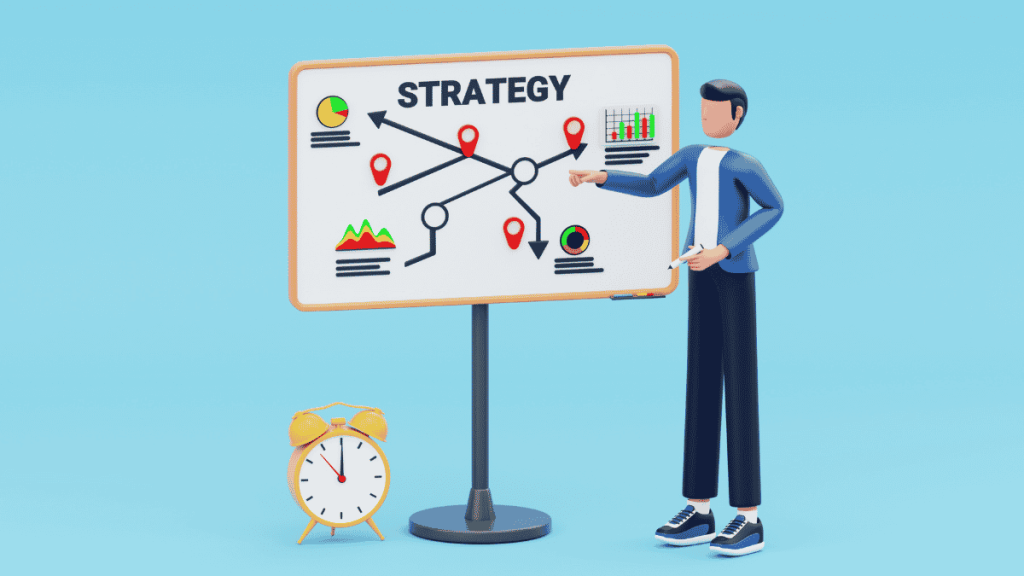
Pairing your roadmap with a winning business plan for your startup gives stakeholders the full strategic picture and closes the gap between vision and fundable documentation.
What Are the Most Critical Launch Steps in a Startup Roadmap?
The most critical launch steps in a startup roadmap are market validation, MVP development, go-to-market activation, early customer feedback collection, and milestone-gated scaling, each of which must occur in deliberate sequence before significant capital is deployed.
Canadian founders who treat these steps as a sequential progression, rather than a simultaneous scramble, experience significantly less waste and more efficient use of early-stage capital.
Here is the proven sequence:
- Validate the market assumption before committing to product development
- Define and build the minimum viable product (MVP) to test core functionality
- Activate the go-to-market plan targeting early adopters, not the full market
- Collect and apply customer feedback within the first 30 to 60 days post-launch
- Measure performance against pre-set milestones and adjust before scaling spend
If you are building these steps for the first time, our post on how to write a business plan walks through the documentation that supports each launch milestone.
The logic is simple: validating assumptions before heavy investment means you can pivot without destroying the business. A startup planning service builds these checkpoints directly into the roadmap so that no significant spend is authorized until the previous milestone is confirmed.
How Does Roadmap Development Build a Strong Startup Structure?
Business roadmap development builds startup structure by formalizing team roles, operational workflows, decision-making hierarchies, and resource allocation across every growth stage, so that scaling adds momentum rather than chaos.
In the earliest days, startups run on informal energy. Everyone does everything. That works at five people. It breaks at fifteen. Without a defined startup structure embedded in the roadmap, growth creates confusion rather than traction.
A capacity-mapping exercise, which is a standard component of professional startup consulting, identifies every business function the company needs today and in the next 12 to 24 months, then prioritizes which capabilities to build, hire for, or outsource.
Structured roadmap development answers the operational questions that stall founders:
- Who owns product quality and who owns sales?
- How are resources divided between customer acquisition and product improvement?
- What compliance and regulatory requirements apply as the company scales in Canada?
- When does the team need to hire, and into which functions first?
Founders who operate without this clarity routinely find themselves making the same decisions repeatedly, burning time that should be going toward execution.
How Does a Business Roadmap Improve Execution?
A business roadmap improves execution by converting high-level business goals into time-bound milestones with named owners, eliminating ambiguity and replacing reactive firefighting with proactive, prioritized progress.
Execution without a roadmap is reactive by default. Teams prioritize whatever feels urgent rather than what moves the business forward strategically. Resources flow toward noise instead of growth. Decisions get made by whoever is loudest in the room.
Milestones change that dynamic entirely. A milestone is a specific goal assigned to a named person or team, with a defined deadline. A business plan without milestones cannot become a real business, because there is no mechanism to convert intention into action.
When milestones are built into the roadmap, execution becomes proactive. Teams know what success looks like for the next 30, 60, and 90 days. Founders can identify bottlenecks before they stall momentum. Investors can track progress against a shared definition of results.
For Canadian startups in competitive industries, from SaaS and fintech to professional services and clean technology, the ability to execute with precision against a defined roadmap separates the 10 % that scale from the 90 % that do not.
When Should a Startup Invest in Business Planning Services?
A startup should invest in business planning services at the earliest possible stage, ideally before product development begins, and certainly before seeking external funding or making significant hires.
The cost of building incorrectly is always higher than the cost of planning correctly. A startup that spends three months developing a product before validating market demand can lose far more than three months’ worth of time and capital.
Professional startup consulting gives founders the strategic frameworks, market knowledge, and milestone structures that take years to develop independently. With Canadian founders already losing over 256 hours annually to administrative and regulatory obligations, few have the bandwidth to build a rigorous roadmap while simultaneously managing product, team, sales, and compliance.
SAZ SQUARE Business Consultants partners with Canadian founders at the pre-revenue, pre-launch, and early-growth stages to develop business roadmaps that align with both investor expectations and real-world market conditions. If you need a founder plan, a structured execution framework, or comprehensive business planning services that cover startup structure through scaling, roadmap development is where the work begins.
Your Roadmap, Your Advantage
The data is unambiguous. Canadian startups face one of the highest failure rates in the world, and the causes are almost always strategic rather than technical. Business roadmap development for startups is the single most effective tool founders have to reduce that risk.
A well-built roadmap defines your startup structure, clarifies your founder plan, sequences your launch steps, creates milestone accountability, and provides the execution framework that drives growth at every stage.
The right time to build your roadmap is before you need it.
Ready to develop a roadmap that works for your startup? Meet with SAZ SQUARE team today for a strategy consultation aligned to your stage, your market, and your goals.
SAZ SQUARE Business Consultants provides expert business strategy, startup consulting, and business planning services to Canadian founders and growth-stage companies. Visit sazsquare.com to learn more.
FAQs
What is the roadmap of business development?
A business development roadmap maps out growth goals, target markets, client acquisition strategies, key milestones, and realistic timelines for measurable expansion.
Can ChatGPT create a roadmap?
ChatGPT can draft a basic roadmap outline, but it cannot replace the market research, financial context, and strategic accountability that professional consulting provides.
What are the 5 stages of a business plan?
The five stages are executive summary, market analysis, organizational structure, financial projections, and growth strategy. Each stage builds directly on the last.
What are the 7 steps of a business plan?
The seven steps are executive summary, company overview, market research, product or service description, marketing plan, financial projections, and supporting appendix.
What comes first, strategy or roadmap?
Strategy always comes first. A roadmap then translates that strategy into milestones, timelines, and execution steps. Without strategy, a roadmap has no direction.