

Canada’s startup and investment environment is now bigger and more competitive than it has ever been. Canadian venture capital totalled $9.13 billion across 598 financings in 2025, and total Canadian startup funding reached $8.2 billion in 2024 – a 62 % increase from 2023. With that kind of capital moving through the ecosystem, you might think securing investment is easier than before.
In reality, the opposite is true.
A typical venture capitalist (VC) or angel investor may see hundreds of startup pitch decks every year, spending just 2–5 minutes reading each story before deciding whether to meet with the founder. That is the window you have to make your case. A poorly constructed investment proposal gets discarded in minutes; a compelling, data-backed pitch deck for investors can open doors that months of cold outreach cannot.
This piece is for Canadian founders and business owners who want to raise money the right way – with a professional, strategically structured pitch deck that speaks directly to what investors are looking for right now.
What Is a Pitch Deck, and Why Does It Matter?
A pitch deck is a presentation that outlines your value proposition, vision, market opportunity, business model, and financial projections.
But it is much more than a slide deck.
It is a storytelling tool – not just data or visuals, but a narrative that connects with your audience emotionally and logically.
According to a 2024 LinkedIn study, 78 % of investors say a clear pitch deck is a top factor in funding decisions. A 2024 poll also found that 65 % of investors judge a pitch’s quality by its design within the first minute.
For Canadian founders specifically, this matters even more. Canadian startups take between 15 % and 40 % longer to start raising money than their U.S. peers, and seed rounds in Canada’s top tech cities are significantly smaller than comparable U.S. hubs.
A polished, investor-ready pitch deck is one of the most direct ways to close that gap.
The Canadian Investment Landscape
Before you build your deck, understand the environment you are pitching into.
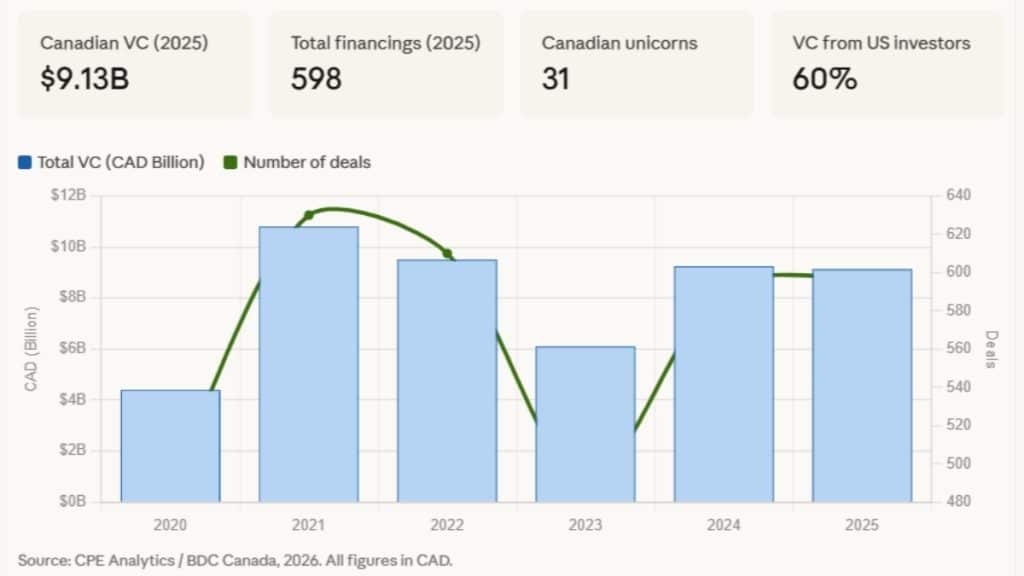
Canada now ranks #5 globally in startup ecosystem strength according to StartupBlink’s 2025 Global Startup Ecosystem Index, with Toronto maintaining its position as the #4 ranked startup ecosystem globally. Despite this, approximately 60 % of VC investments in 2025 were made by U.S. investors – the highest percentage since 2017.
What does this mean for your pitch deck? It means your business presentation must speak both to domestic investors who understand the Canadian regulatory and market context, and to U.S.-based VCs who are evaluating your company against opportunities south of the border. Your deck needs to be globally credible while being locally grounded.
Series A rounds in Canada averaged $22 million in 2025, up from $15 million in 2023, reflecting higher investor expectations. This means your financial planning slides must reflect a more sophisticated understanding of traction, unit economics, and scalability than was required just a few years ago.
The Proven 10-Slide Pitch Deck Structure That Works
| # | Slide | What to include | Why investors care |
|---|---|---|---|
| 1 | Cover/Title | Company name, tagline, value proposition, funding round | Sets tone; 65 % of investors judge quality in the first minute |
| 2 | Problem | Clear pain point, market gap, data-backed urgency | Validates why the business needs to exist |
| 3 | Solution | Product/service overview, unique differentiators, visuals or mockups | Shows innovation and problem-solution fit |
| 4 | Market Opportunity | TAM/SAM/SOM breakdown, Canadian market specifics | Determines scalability potential and ROI ceiling |
| 5 | Business Model | Revenue streams, pricing strategy, unit economics | Investors spend 48 % more time here than 2 years ago |
| 6 | Traction | Revenue, user growth, partnerships, pilot results | Proof of market demand beyond theory |
| 7 | Competitive Landscape | Competitor matrix, your unfair advantage, moat | Shows strategic awareness and defensibility |
| 8 | Team | Key members, credentials, relevant wins | Investors back people as much as ideas |
| 9 | Financials | 3-5 year projections, burn rate, path to profitability | Demonstrates financial literacy and realism |
| 10 | The Ask | Funding amount, use of funds (pie chart), milestones | Clarity here increases meeting conversion by 25 % |
The table above outlines the ten core slides that form the backbone of every winning investor pitch deck.
Here is how to approach the most critical of them.
1. The Problem Slide: Start with Urgency
Investors need to be on board with understanding why this is a problem that even needs to be solved – this is crucial context-setting for your pitch. Do not open with your product. Open with the pain. Use hard data: market reports, government statistics, or industry surveys. A Canadian founder pitching a health-tech solution, for example, should cite current wait times or coverage gaps in the provincial system rather than speaking in generalities.
2. The Solution Slide: Clarity Over Complexity
The gold-standard pitch decks don’t dazzle with technical jargon – they open with a clear, urgent problem statement, followed by a direct explanation of the solution in plain language so that investors from both technical and generalist backgrounds can understand it in minutes. Use visuals, mockups, or screenshots. Avoid feature lists. Focus on the transformation your product creates for the customer.
3. Market Opportunity: Show the Size of the Prize
Your market opportunity slide must go beyond a single big number. Break it down into TAM (Total Addressable Market), SAM (Serviceable Addressable Market), and SOM (Serviceable Obtainable Market). For a Canadian pitch, anchor your SOM with realistic Canadian market penetration figures. Toronto alone accounts for approximately 40 % of all venture capital investment in Canada, making city-level market specificity a credible and relevant framing.
4. Business Model and Financials: The Most Scrutinized Slides
According to DocSend and PitchGrade data, investors now spend 48 % more time analyzing business model slides than they did two years ago. This is no longer a supporting slide – it is often the deciding one.
In 2025, VCs demand pitch decks that are clear, data-driven, and focused on long-term profitability. Flashy visuals and vague projections no longer work. Instead, investors prioritize proven traction, market validation, realistic financials with transparent assumptions, team expertise, and a clear path to scalability.
Your financial projections should cover three to five years. Show your burn rate, your path to break-even, and your unit economics. Avoid hockey-stick projections without backing them up with assumptions grounded in your existing customer behaviour and pricing model.
👉 If you are unsure who to work with to build your financial projections, understanding the difference between a financial advisor vs. business consultant is a useful first step.
5. Traction: Proof Beats Promises
Nothing accelerates a funding conversation faster than demonstrated traction. If you are an early-stage startup without substantial revenue, focus on leading indicators such as pilot program results, pre-orders, or engagement metrics. External validation like partnerships with well-known brands, regulatory approvals, or technical advancements can also build strong credibility.
For Canadian startups, participation in recognized accelerators like MaRS Discovery District, Communitech, or Innovate BC carries meaningful weight with domestic investors and signals a level of vetting that international investors respect.
6. The Ask: Make It Impossible to Misunderstand
According to TechCrunch, startups with clear calls to action in their pitch decks are 25 % more likely to secure meetings after the initial presentation. State your funding amount clearly. Break down exactly how you will deploy the capital – product development, hiring, go-to-market, operations – and tie each allocation to a specific milestone. Use a simple distribution chart rather than lengthy prose.
Why Design Is Not Optional
According to Venngage, 90 % of investors say visual content improves understanding and retention. A well-designed fundraising pitch deck is not about aesthetics for their own sake – it signals that you are professional, detail-oriented, and understand your audience. Cluttered slides, inconsistent fonts, and low-quality visuals communicate the opposite.
Effective pitch deck design tips for Canadian founders include: keeping each slide focused on a single idea, using your brand colours consistently, replacing text-heavy bullets with visuals or charts wherever possible, and ensuring the deck is legible at presentation size as well as when read as a PDF. If you are at a seed or late-seed stage, keep your deck between 15 and 20 slides – shorter is always better.
Common Pitch Deck Mistakes That Cost Funding
Based on patterns seen across hundreds of investor presentations, these are the most consistent failure points:
Over-pitching the product. Founders often fall into the trap of over-pitching their product and selling it to investors, but pitching a startup is more than pitching a product. The opportunity and market size, the business model, the commercialization plan, and the financials are equally important in investors’ eyes.
Unrealistic financial projections. Revenue projections should be realistic and grounded in actual customer behaviour and pricing models that have been tested and validated. Investors have seen too many “conservative” models that assume 10 % market capture in year two with no justification.
A weak or missing team slide. You have to pitch your team if you want to get the money. You could have an amazing plan, but if you do not have the right people to implement it, it is all for nothing.
No clear ask. Ending a deck without a specific, quantified funding request leaves investors with no way to move forward. Be direct about how much you need, on what terms, and what you will achieve with it.
Key Statistics Summary
| Metric | Figure | Source |
|---|---|---|
| Canadian VC investment (2025) | $9.13 billion | CPE Analytics |
| Canadian VC deals (2025) | 598 financings | CPE Analytics |
| Canadian startup funding growth (2024) | +62 % YoY | Growth List |
| Share of VC from U.S. investors | 60 % (2025) | CPE Analytics |
| Median Series A round, Canada (2025) | $22 million | Shoutex |
| Investors citing pitch deck as top factor | 78 % | LinkedIn 2024 |
| Investors judging quality within first minute | 65 % | 2024 Industry Poll |
| Increased time spent on business model slides | +48 % | DocSend/PitchGrade |
| Startups with clear CTA getting more meetings | +25 % | TechCrunch 2024 |
| Investors who say visuals improve retention | 90 % | Venngage |
How SAZ SQUARE Helps You Build a Winning Pitch Deck
At SAZ SQUARE Business Consultants, we specialize in helping Canadian businesses translate their vision into investment-ready pitch decks. Our approach combines financial planning rigour, business strategy, and presentation design to create documents that speak directly to investor interests – whether you are targeting angel investors, Canadian VCs, or U.S.-based funds looking north of the border.
From your investor pitch deck template and structure to your financial projections, competitive analysis, and executive summary, we build every element with your fundraising goals in mind.
👉 See how we’ve delivered real results for Canadian businesses here.
Final Thoughts
In a market where only roughly 6 % of companies founded in 2024 secured early-stage venture funding, the businesses that succeed in raising capital are not necessarily those with the best ideas – they are the ones that communicate their value most clearly and convincingly. A professionally built pitch deck for investors is not a luxury for well-funded startups. It is the baseline requirement for being taken seriously by anyone deploying capital in Canada today.
If you are ready to move from concept to funded, reach out to us now.
👉 We help Canadian entrepreneurs build the investment proposals, financial models, and business presentations that get results – see our business consulting and pitch preparation services to get started.
FAQs
What should an investor pitch deck include?
A strong pitch deck covers the problem, solution, market size, business model, traction, team, financials, and a clear funding ask.
What are the 5 P’s of investing?
The 5 P’s are: People, Product, Process, Projections, and Proof – the five pillars investors evaluate before committing capital to any business.
What is the 10 20 30 rule for pitch deck?
Maximum 10 slides, 20 minutes to present, and no font smaller than 30 points (this rule was coined by Guy Kawasaki.) Simple, but still relevant.
What is a pitch deck in investment?
A pitch deck is a short, visual business presentation that communicates your company’s opportunity, model, and funding needs to potential investors.
Can ChatGPT create a pitch deck?
ChatGPT can draft pitch deck content and structure, but it cannot replace the strategic financial planning, market insight, and investor-ready positioning a business consultant provides.