

Startup valuation explained clearly and directly matters because it determines how much your business is worth when investors, partners, or buyers assess it. You need to understand valuation to position your business confidently in funding conversations, set reasonable offers, and negotiate from a place of strength.
In Canada’s startup ecosystem, knowing how valuation works helps founders make informed decisions and avoid common pitfalls that can weaken negotiating power or lead to premature dilution of ownership.
Let’s get into what startup valuation means, how it’s done, and how you can use this knowledge for better business outcomes.
What Is Startup Valuation and Why It Matters
Startup valuation starts with understanding that it’s an estimate of how much a startup company is worth at a given point in time. It is not a fixed number but a range influenced by multiple factors. A startup’s valuation matters because it directly affects how much equity you give up in exchange for investment. It also impacts your ability to attract the right investors and align incentives across your team and key stakeholders.
In the early stage of a Canadian startup, traditional financial data is usually limited or unavailable, so valuation depends on a mix of qualitative and quantitative factors. These include your business model, expected growth, team strength, competitive advantage, market opportunity, and any initial traction you have gathered.
Understanding startup valuation helps you plan for funding rounds, communicate value with clarity, and structure offers that work for both founders and investors.
How Startup Valuation Works
At its core, startup valuation explained combining both art and science to estimate worth. There is no single formula because each startup has unique characteristics and potential. Instead, investors and founders use several methods to triangulate a reasonable valuation range.
First, valuation takes into account projections of future performance. Even if your company has no revenue yet, estimates of future cash flows, growth potential, and market adoption play a central role.
Second, narratives and benchmarks are used to justify valuation ranges by comparing your business to similar companies.
Together, these elements form a snapshot of expected value at a specific point in time.
Put simply, startup valuation shows how investors balance risk and return while founders assess their growth prospects.
Common Startup Valuation Methods
There are several methods used to value startups at different stages. Each one is suitable in specific scenarios and often multiple techniques are used together for a stronger case.
Early‑Stage and Pre‑Revenue Valuation
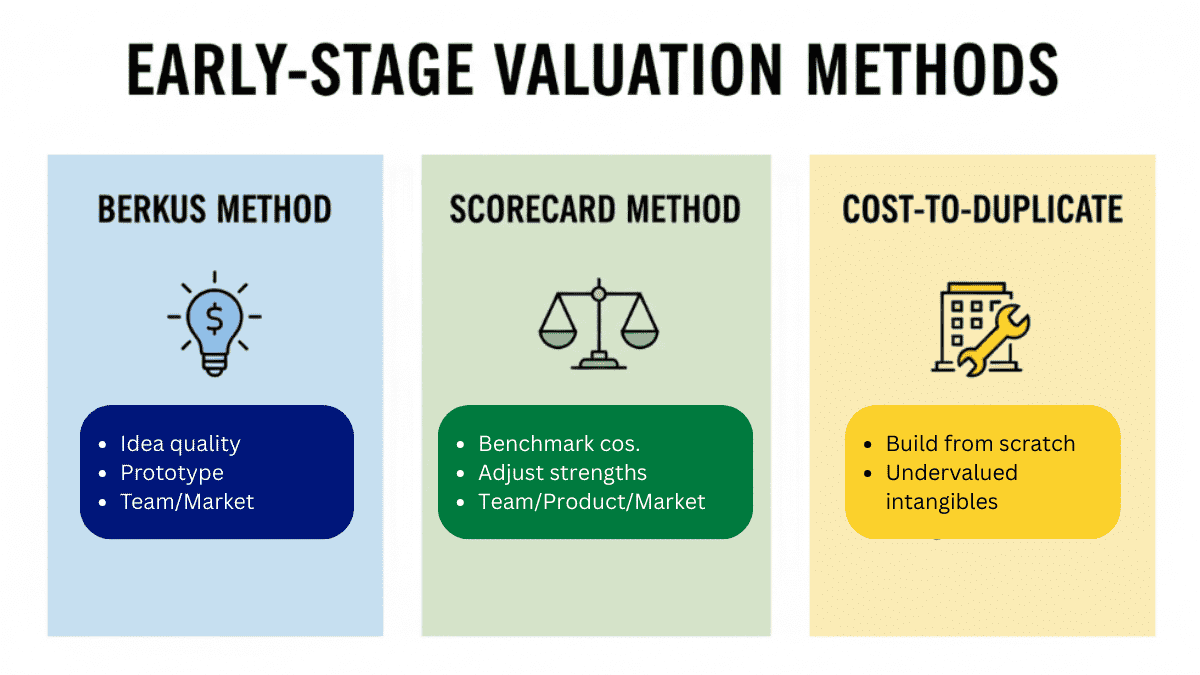
1. Berkus Method
The Berkus Method assigns dollar values to five key success factors like idea quality, prototype, management team, market opportunities, and sales channels. This approach is especially useful for startups without revenue because it focuses on qualitative indicators of future success.
2. Scorecard Method
This method compares your startup to a benchmark set of similar companies. The valuation is adjusted based on strengths and weaknesses across criteria such as team experience, product readiness, and market potential. It is widely used by angel investors.
3. Cost‑to‑Duplicate
You estimate how much it would cost to build your business from scratch. This can serve as a baseline valuation but may undervalue startups with strong intangible assets.
Revenue‑Based and Financial Methods
1. Discounted Cash Flow (DCF) Method
This method forecasts future cash flows and discounts them to present value using an appropriate discount rate. It emphasizes expected earnings but requires reasonable assumptions about future performance.
2. Market Multiple Method
Here, valuation is estimated by applying a revenue or earnings multiple based on comparable companies in similar industries. This method is common when your startup is generating revenue.
Venture Capital and Exit‑Focused Methods
1. Venture Capital (VC) Method
The VC Method involves estimating the company’s worth at a future exit event and discounting it to the present based on expected return on investment. This method is focused on outcomes like acquisition or IPO.
2. First Chicago Method
This involves building scenarios for upside, base, and downside outcomes. It combines both multiples and discounted future earnings to arrive at a balanced valuation range.
How Startup Valuation Is Calculated
To calculate valuation using methods like DCF or multiples, you need financial projections and relevant market data. In DCF, projected cash flows over a period are discounted using a rate that reflects investment risk. The sum of those discounted values equals the estimated worth.
In the multiples approach, you identify comparable companies’ valuation ratios then apply them to your financial metric, commonly revenue or EBITDA. For example, if similar businesses are valued at three times annual revenue, you multiply your revenue by three to estimate valuation.
Comparison of Valuation Methods
Below is how different methods approach valuation:
| Method | Applicable Stage | Key Inputs |
|---|---|---|
| Berkus Method | Pre‑revenue | Qualitative success factors |
| Scorecard Method | Seed/pre‑revenue | Benchmark comparisons |
| Cost‑to‑Duplicate | Early | Development cost baseline |
| DCF Method | Revenue generating | Future cash flows & discount |
| Revenue Multiple | Revenue generating | Revenue & market multiples |
| VC Method | Early to growth | Exit value & ROI expectations |
What Influences Startup Valuation in Canada
In Canada, the startup ecosystem has unique characteristics that influence valuation outcomes.
Many early‑stage companies operate in sectors like technology and clean energy, where growth potential and intellectual property matter greatly. Investors may consider factors such as market size in North America, projected regulatory changes, and potential for export when assessing value.
Programs like SR&ED tax credits or provincial innovation grants indirectly influence valuations because they alter projected earnings and risk profiles. Founders with strong technology and demonstrated initial traction often secure higher valuations than those without measurable benchmarks.
Common Startup Valuation Queries
Entrepreneurs often ask, “what is a good valuation for a company?” A ‘good’ valuation is one that reflects the realistic potential of the business and aligns with investor expectations while preserving sufficient equity for founders.
Another common question is: how to value a startup without revenue? Methods like Berkus and Scorecard are designed for these cases because they focus less on financial history and more on indicators of future success.
Mistakes to Avoid When Valuing Your Startup
Valuation is not an exact science. Overestimation can lead to difficulties in future funding rounds if performance fails to meet expectations.
Conversely, undervaluation can cost founders unnecessary equity.
Avoid ignoring qualitative indicators, relying on a single method, or neglecting market comparables. Using more than one method gives a balanced view and helps justify valuation claims robustly.
Bringing It All Together
Startup valuation is crucial for founders at every stage. Understanding how startup valuation works, and the methods available gives you clarity in discussions with investors and in strategic decisions.
Remember that valuation reflects expectations of future performance and is influenced by a combination of qualitative and quantitative factors.
For startups serious about growth, having valuation literacy positions them to negotiate effectively and set milestones that meaningfully reflect value.
👉 Curious how valuation connects with broader financial planning? Check out our piece Notice to Reader Financial Statements in Canada.
▶ ️ And if you’re weighing growth versus acquisition, see our comparison of starting or buying a business in Canada here.
FAQs
What is a good valuation for a startup?
A good valuation is one that reflects realistic growth potential and aligns with investor expectations.
How is a startup valuation calculated? (with example)
Valuation is estimated by applying multiples like revenue times an industry factor, e.g., $1M × 5 = $5M.
How do revenue multiples work?
Revenue multiples compare a company’s market value to its annual revenue to help gauge its worth.
Which valuation method is most popular?
The market multiples approach is widely used for valuing startups with revenue data.
Why is startup valuation important?
Valuation guides funding negotiations and shows how much of the company investors should own.